You are visiting the United Kingdom Kee Safety website from United States. Would you like to go to the United States site?
You are visiting the United Kingdom Kee Safety website from United States. Would you like to go to the United States site?

The Construction Design and Management Regulations 2015 place clear responsibilities on those involved in construction to manage risk from the earliest stage of a project. One of the most significant risks across construction and maintenance activity is working at height, where a fall can lead to serious injury or loss of life.
Effective fall protection is not something that should be added later. It must be considered from the first place in project planning. By integrating fall protection systems into design, construction teams can reduce risk, improve safety, and ensure long-term compliance with height regulations.
The CDM regulations are designed to improve health, safety, and risk management throughout a project lifecycle. They place duties on clients, designers, and contractors to ensure that hazards are identified early and controlled effectively.
For working at height, this means that fall protection systems must be planned before construction begins, rather than relying on temporary solutions once the job is underway. When fall protection is considered early, it becomes part of the building design, not an afterthought.
Height regulations require that risks are avoided where possible and controlled where they cannot be eliminated. This makes fall prevention and suitable protection systems central to compliance.

Planning edge protection early helps construction teams reduce working at height risk before site activity begins.
Falls continue to be one of the most common causes of injury in construction. A fall from even a short distance can have serious consequences, particularly when working on roofs or elevated structures.
CDM requires duty holders to assess each fall hazard and apply appropriate measures to prevent falls or minimise the consequences if a fall does occur. This includes selecting the right fall protection equipment and ensuring that systems are suitable for the working environment.
By prioritising fall protection systems, project teams can create safer working conditions and reduce reliance on reactive measures such as fall arrest equipment alone.
Under CDM regulations, fall protection is a shared responsibility across multiple roles.
Clients must ensure that sufficient time and resources are allocated so that fall protection systems can be properly designed and implemented. Principal designers are responsible for eliminating or reducing fall risk through design decisions. This may include specifying guardrails, safe roof access routes, or permanent protection systems.
Principal contractors must then implement these measures on site, ensuring that fall protection equipment is installed correctly and that workers are trained to use it safely. This includes ensuring that personal protective equipment, such as a body harness or full body harness, is used correctly when required.

CDM places responsibility on project teams to design safe roof access and fall protection into the building from the outset.
The most effective way to manage fall risk is to address it at the design stage. Where possible, designers should aim for fall elimination by removing the need to work at height altogether. Where this is not possible, collective protection such as safety barriers or guardrails should be considered as the preferred solution.
For example, specifying roof edge protection systems and safe rooftop walkway systems can reduce the need for ladders or temporary access equipment. Kee Safety also provides step over platforms that allow safe movement across rooftop obstacles while maintaining continuous protection.
This approach reduces risk across the life of the building and ensures that maintenance teams and future contractors can work safely.
CDM reinforces the hierarchy of control, where collective protection is prioritised over personal protection systems. Collective fall protection protects everyone in the work area without relying on individual behaviour.
However, there are situations where personal protection systems are required. These include environments where edge protection cannot be installed or where access is restricted. In these cases, systems such as horizontal lifeline systems, temporary anchors, and other specialist solutions are used.
A fall restraint system can prevent a person from reaching a fall hazard, while a fall arrest system is designed to stop a fall in the event of a fall occurring. This may involve fall arrest blocks and a body harness connected to a secure anchor point.
It is important to understand that fall arrest equipment does not prevent a fall. It reduces the consequences. This is why collective protection remains the preferred solution wherever possible.

Combining guardrails with safe access systems supports collective fall protection and reduces reliance on personal equipment.
Choosing the right fall protection equipment depends on the specific working environment, the nature of the task, and the level of risk involved. A detailed risk assessment should consider the work area, roof access systems, and the potential fall distance.
Fall protection systems must be compatible with the structure and designed to withstand the force generated in the event of a fall. This includes selecting suitable anchor devices, such as deadweight anchors or fixed systems, depending on the roof type.
Training is equally important. Workers must receive user training to understand how to use fall protection equipment correctly, including how to inspect equipment before use and how to respond in the event of a fall. A rescue plan must also be in place.
Fall protection systems require ongoing inspection and maintenance to ensure they remain effective. Equipment such as fall arrest blocks, harnesses, and lifelines must be checked regularly to confirm they are safe to use.
User training should be refreshed periodically so that workers understand how to use personal protective equipment and specialist PPE correctly. Without proper training, even the best systems can fail to protect workers effectively.
Regular inspection also ensures that any damage or wear is identified before it leads to failure.
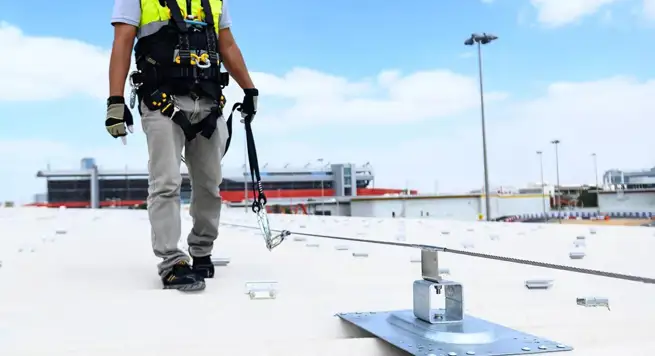
Where collective protection is not possible, lifelines and fall arrest systems help manage risk in complex working environments.
Kee Safety supports clients at every stage of a project, from design through to installation and ongoing maintenance. As specialists in fall protection systems and height safety, Kee Safety provides practical solutions that help clients manage risk and comply with regulations.
From guardrails and access systems to lifelines and fall arrest solutions, Kee Safety offers a comprehensive range of safety solutions designed to protect workers and reduce the risk of falls.
Fall protection is a fundamental part of CDM compliance. By considering fall protection systems at the earliest stage of a project, duty holders can prevent falls, minimise risk, and protect workers throughout the life of a building.
While personal protection systems such as fall arrest equipment play an important role, they should not be relied on as the primary control measure. Instead, a balanced approach that prioritises collective protection and supports it with suitable fall protection equipment will deliver the best results.